The Applause

On Monday night in Grand Island, Nebraska, at the Pinnacle Bank Expo Center on the state fairgrounds, the President of the United States was explaining why gasoline costs what it costs. He was there for Senator Pete Ricketts, who is in a closer race than a Nebraska Republican is supposed to be, and the subject was the war. "It's a small price to pay for keeping the world safe, keeping our country safe," he said. "They could take out a city. Let them take out Los Angeles. Let them take out San Diego. This is a very small price to pay, and it's gonna be over with very soon." The crowd applauded and cheered.
Fairness first, and this paper owes it more than most. Six days ago it spent a full column on people who cut a tape before the answer, so here is the rest of this one. The sentence before the cities is about the price of gas, which the President called "artificial" and "a little bit high." The sentences after are about the war ending soon. On Tuesday the White House communications director, Steven Cheung, said the "media freakout" was "not rooted in reality" and that the President "was clearly stating U.S. cities would have been threatened if a nuclear Iran hadn't been stopped." CNN's fact-checker, Daniel Dale, who has not made a career of rescuing this President, said of one viral paraphrase that he very much did not think it was correct. The Los Angeles Times allowed that the line was "possibly in jest." Read with all the charity the transcript will bear, the President meant something like this: an Iran with a bomb could take out a city, nobody should want to let it, and four-dollar gas is cheap by comparison. The paper thinks that is probably what he meant. It will not print that he asked Iran to bomb California, because the tape does not prove it.
Now take the kind version and look at what is still on the table. The kind version is that the President reached for the worst thing he could imagine to justify a gas price, and what came to hand was two American cities with names. He did not say a city. He said Los Angeles, where he sent the National Guard and the Marines last year, and San Diego, where more than a hundred thousand service members and their families live and where the carrier Abraham Lincoln, at sea past three hundred days in his war, is supposed to come home. He did not say Omaha. The words that left his mouth, in order, were "let them," twice, and then "this is a very small price to pay." The premise does not hold either. His own Director of National Intelligence told the Senate in March that Iran was not building a weapon, and nobody has produced intelligence that Iran can reach California with anything. So the country was asked to weigh a real four dollars against an imaginary fireball over a real city. And the President has not, as of this writing, said the one sentence that would end the matter, which is that of course he did not mean it. He left that to a spokesman, who used the occasion to attack the people who quoted him.
Then there is the applause, which no spokesman has explained. The crowd did not have Cheung's statement. It had the words as they came, and at "let them take out Los Angeles" it cheered. The paper cannot read a room's mind from a tape. Perhaps a hall full of Nebraskans parsed a buried conditional in real time, faster than CNN's fact-checker, and was applauding nuclear nonproliferation. Or perhaps they heard what the rest of the country heard, that a city of nearly four million Americans could go, and that this would be tolerable because of which Americans they are. The paper knows which explanation it finds more natural. So does everyone who watched.
Twenty-five years and twenty-four days before that rally, somebody did take out part of an American city. The President of the day spent some of that afternoon in a bunker at Offutt Air Force Base, a couple of hours east of Grand Island. That evening about a hundred and fifty members of Congress, from both parties, stood on the Capitol steps and sang "God Bless America," not well, and together. Three days later Congress voted forty billion dollars in emergency money, 422 to 0 in the House and 96 to 0 in the Senate, with half of it promised to a city that had voted overwhelmingly against the man signing the check. Nobody in either chamber asked how Manhattan voted. Gallup put that President's approval at ninety percent, the highest it has ever measured for anyone. A French newspaper ran the headline "We are all Americans." NATO invoked its mutual defense clause for the first time in its history, on America's behalf.
The paper will not sell that as a golden age. It lasted weeks. Four days after the attack a Sikh man named Balbir Singh Sodhi was shot dead at his gas station in Mesa, Arizona, by a man who wanted to kill an Arab, and within eighteen months the unity had been spent on a war in Iraq, sold on weapons that were not there. But one episode from that week is worth setting next to this one. On September 13, 2001, Jerry Falwell went on television and said that the abortionists and the feminists and the gays and the ACLU had helped this happen. He was a preacher with no office. The Republican White House called the remark inappropriate the next day and said the President did not share those views, and Falwell apologized within the week. That was the rule in 2001. A man who suggested that Americans in a blue city had it coming was corrected by his own side inside twenty-four hours. In 2026 the words came from the President himself, and the correction was issued to the press.
Which brings the paper to the Republican majorities in Congress. As of this writing it could find no statement about Monday night from Speaker Johnson, from Leader Thune, or from Senator Ricketts, whose rally it was. The Republicans on record are two. Jim Desmond, a San Diego County supervisor and Navy veteran who is running for Congress and is not yet in it, said that "no American city is expendable." Kevin Kiley called the rhetoric "unhelpful," and Kiley has left the party. The California Republican Party declined to comment. So the count of sitting Republicans in Congress willing to say that Los Angeles should not be taken out stands, as far as the paper can find, at zero. These are not people who lack opinions about California. The Speaker said last year that its governor ought to be tarred and feathered. Nor do they lack the ability. In February, Ricketts asked the President to apologize for a video depicting the Obamas as apes, so he knows where the microphone is. The Constitution handed this branch the war power, the purse and impeachment. It voted three times this summer to end the war, in resolutions it knew had no force, and this week it has not managed a press release. Silence is not neutral when it comes from the only people with the standing to object. It is the answer.
The press did cover it, and the paper will say so, because the complaint is not that the story was buried. Look at the headlines instead. The President "draws backlash." The President "sparks outrage." The President "sparks criticism." In every one of them the event has moved into a subordinate clause and the news is that Democrats are upset, which is a dispute, which has two sides, which is a panel. A few outlets overshot the quote and handed the White House its "media freakout." By the weekend it will be an item in a list, behind the Signal chats and the war that ends after the election, each of which was also a two-day story with a backlash. Nobody decides to normalize anything. It is what remains when every new low gets forty-eight hours and a chyron. In 2016 the chairman of CBS said of this man's first campaign that it might not be good for America but it was damn good for CBS. Nothing since suggests the arithmetic has changed.
In 1983 Roger Waters wrote a song for the Pink Floyd album The Final Cut called "The Fletcher Memorial Home." Fletcher was his father's middle name. Eric Fletcher Waters was killed at Anzio in 1944, when his son was five months old. The song proposes an institution, a retirement home for heads of state who cannot be cured of it, where Reagan and Thatcher and Brezhnev and Begin and the ghost of Joe McCarthy can be kept together, out of harm's way, with closed-circuit television so that they can watch themselves and be sure they are still real. It was written about the Falklands, a small war that did a great deal for an election. The song ends with a verse this paper will not co-sign. The home is enough, and it has never had a longer waiting list. What Waters got wrong was only the television. He assumed its residents would have to be their own audience. He did not picture a hall in Nebraska.
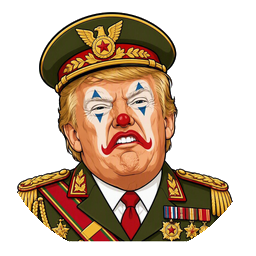
Five clowns. Not for the sentence, which the paper has allowed may be a mangled boast. For the choice of cities, for the cheer, for the morning-after spokesman, and for the majority that heard all of it and checked its phone. For a few weeks in 2001 an attack on one American city was an attack on all of them. The standard in 2026 is that it depends on the city. The election is November 3.