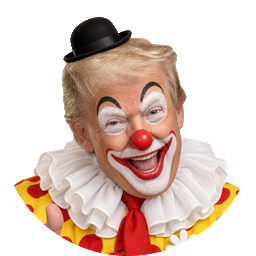
The Man on Every Ballot but One
"Just pretend, because I really am on the ballot," the President told Lubbock last Tuesday night, which is the clearest he has put it, until Dubuque on Sunday: "Pretend I'm on the ballot because, essentially, I am on the ballot." In Corpus Christi last Tuesday afternoon it was "We get 49.2 percent more votes when I'm on the ballot, and we always win," and "I've done 26 of them now." In Corinth the night before that: "I'm asking you to pretend that I'm on the ballot." Perry, Fort Myers, Sioux City, Pendleton, Greenville, Park City, Dalton, Bullhead City, all the same sentence, back to Durant, Oklahoma, on October 1, where it came with the reason: "If we don't win, they'll end up impeaching me." The paper has spent two weeks rating the Republicans who would like to be elected today with the President's endorsement and without the President, and it thought it should close by rating the man himself, who has solved the problem from his end. He is not on any ballot today. He has asked the country to pretend otherwise. The paper, which does not pretend, will instead describe what he has actually been doing with his last two weeks.
Here is the schedule, since nobody else has printed it in one place. Monday, October 19, Park City, Kansas, a state he carried by 16. Tuesday, Greenville, North Carolina, by 3. Wednesday, Pendleton, South Carolina, by 18. Thursday, Sioux City, Iowa, by 13. Friday, Fort Myers, Florida, by 13. Saturday, Perry, Georgia, by 2. Sunday, Port Huron, Michigan, by 1. Monday, Corinth, Mississippi, by 23. Tuesday, Corpus Christi and Lubbock, Texas, by 14, "I don't usually do two rallies for anybody," he told Ken Paxton. Wednesday, Chillicothe, Ohio, by 11, with Senator Husted and Mr. Ramaswamy on the stage before him, in a room so small that a correspondent who has covered hundreds of his rallies said he could not recall one like it. Thursday, Rock Hill, South Carolina, again. Friday, Daytona Beach, Florida, again, with Senator Moody and Mr. Donalds. Saturday, nothing. Sunday, Dubuque, Iowa, again, and then Salina, Kansas, again: "This is my 30th rally," he said there, "and I'm closing it down tonight. This is it." Monday, Washington, which gets its own paragraph below. Nothing today. Fifteen stops in fourteen days, every one in a state he won, and of the states with the closest races in the country, the ones the paper has been writing about, he has not set foot in Wisconsin, where the Governor's race is a toss-up and his approval is 38 percent; or Nevada; or Pennsylvania; or Minnesota, where a week ago Monday he posted that the Republican "can only lose if they cheat" and that "The Federal Government will be watching closely"; or Alaska, since October 13. Last Tuesday afternoon, between Texas rallies, he posted an image reading "TEXT WISCONSIN TO 88022, TRUMP VANCE, MAKE AMERICA GREAT AGAIN 2024," with no words, which is the whole of the Wisconsin campaign.
And here is the closing argument, since the paper promised it. On Monday afternoon, the last day before what he called "the most important midterm, I believe, in our lifetime," the President of the United States stood at the Lincoln Memorial Reflecting Pool and talked about the pool. The pool deserves a word. In April he promised it would be resurfaced in "American flag blue" for $1.8 million in a couple of weeks, and that the work "will last for at least 50 years and you'll never have a leak." The no-bid contract went for $13.1 million to a company with no federal work on its record that had done the pool at his golf club, and a second no-bid contract, for the algae, to a donor who once pleaded guilty to bribing a congressman. It reopened June 6. The water was green within days and the blue was peeling within two weeks. The President blamed vandals, and his Justice Department indicted a 67-year-old Olympic canoeist on a felony carrying ten years for touching a strip of it. The pool was drained again in July. On July 31 the same Justice Department moved to dismiss its own case, because the peeling was the product of a "hasty and botched" renovation and "not vandalism," and the contractor's own report in August said the same; the judge who threw the canoeist's case out for good on October 1 called the chance of another one "simply fanciful." It was refilled, quietly, in the last three weeks, and on Monday he stood in front of it, announced its reopening, and joked about naming it after himself. He went through the other things he has had repaved and repainted in the capital, and said, "We have a lot of great things planned for Washington, and I could get into the nation, but for that, you don't have enough time." Twenty minutes in, he got to the election. The Democrats had "nominated the most extreme and dangerous slate of candidates in American history." The $5,000 check if Republicans hold Congress was promised again. He allowed, for the record, that the President's party "doesn't win the midterms." He named Mr. El-Sayed in Michigan, and a Dan Sullivan in Alaska who turned out to be the schoolteacher and not the Senator, and not one Republican on any ballot in the country. The White House had said there would be no rallies that day, and there were none; there were nine telephone calls instead, Mr. Lawler's first, "so that I could do it before I blow the voice entirely," Senator Graham's, "our voices are hanging in by a thread, and that's good," and ten minutes for Mrs. Letlow in Louisiana, the first time he had campaigned for her at all. The man who asked twenty-six arenas to pretend he was on the ballot spent the eve of the election on a pool, and the two weeks before it in the states where that pretense still works. The paper would call it a closing argument. It was a closing argument about the pool.
Here is why the schedule looks like that. The Republicans running in the close races have taken him off their air: an advertising tracker counted the President in 1 percent of Republican ads in October against 47 percent in May, and the Times found that of $830 million the party's side spent after Labor Day, less than one percent of it mentioned him. His approval is 32 percent in the Reuters poll that finished Monday, one point above his own record low, 36 to 64 in Fox's, 38 to 59 in the Silver Bulletin average, and the Times calculated that no President since Truman has gone into a midterm lower. State by state, among registered voters, he is 23 under water in Wisconsin, 28 in Michigan, 23 in Pennsylvania, 26 in Georgia, 24 in Nevada, 22 in Iowa, 21 in Ohio, 12 in Alaska, 11 in Mississippi. The one state on the list where more people approve than not is Kansas, by two, and he has been there twice. The generic ballot is Democrats plus nine in the average and plus eight in Monday's Reuters poll, down from eleven the week before. The markets have the House at nineteen in twenty for the Democrats and the Senate at three in four. By Sunday morning 53 million Americans had voted early, more than the 46 million who voted early in all of 2022, and in the states that register by party more than 11 million of them were Democrats against about 8 million Republicans; back on October 23, when the count was 23 million, the professor who counts these things said, "Democrats and unaffiliateds are engaged. Republicans are not as engaged." The President's answer to all of it is the sentence. If his people think he is on the ballot they will come. The White House's answer, from its spokesman, is that he is "the unequivocal leader, best messenger, and unmatched motivator for the Republican Party," which the paper quotes because it is the last sentence of its kind that will be said this cycle.
Now the ledger, which is the point of the two weeks. The paper has rated ten Republicans since October 22, one a day, and of each it asked the same question: find one time the President did something because the candidate asked him to. The answers, with what the fortnight since has added, in one place.
Jon Husted, Ohio, and the delegation asked for storm aid. He got a disaster declaration the day before the Vandalia rally in October, for seven of the 23 counties the Governor requested, and the President said from the stage that he had signed it "at the request of Jon." Rick Jackson, Georgia, asked for nothing on the record and said he would skip the Perry rally for a Kemp event, until his campaign said it had worked out the logistics to do both; he got a $4.2 billion Audi plant announced from the stage. Ashley Hinson, Iowa, did not ask him to drop the Russian diesel deal; she told NBC, "I think that's a bad idea. I don't think we should be making deals with Russia," and said she might raise it with him at the Sioux City rally; from the stage he called her "such a pain," the deal stands, and he was back in Dubuque for her on Sunday. Roger Marshall, Kansas, asked for nothing and got "You got screwed with that stuff," about the medical-debt suits, "kind of a Shylock-type guy," and two rallies, the first of the fortnight and the last of the thirty: "I had to come here to make sure that Roger got elected." Joe Lombardo, Nevada, asked the Governor of California about fuel prices, asked Washington once on paper, about the provider tax, and was told no, and got no visit this fall. Dan Sullivan, Alaska, asked for three things, an Alaska Medicaid carve-out, relief from the Canada tariffs and no Russian diesel deal, and got three noes and a Justice Department lawsuit against his own state's election, filed with a legal argument a Notre Dame professor called "one of the worst ones I've ever seen," which the President says he ordered, "I'm the one that said do it," and which the Senator's campaign is letting "run its course." Tom Tiffany, Wisconsin, asked for disaster money the Governor had already requested and got it twice, announced as phone calls with the candidate, the second one the morning after CBS put the tornado victims on television; Governor Evers said, "Wisconsinites will believe it when we see it." Cindy Hyde-Smith, Mississippi, asked for a rally by the President's account, "They've asked me to go," or was offered one by hers, and got one, and said nine words at it. Darline Graham, South Carolina, asked for her dead brother's Russia sanctions law and got it signed on September 18 and waived on October 16, two days before it took effect, and the next morning got his "Complete and Total Endorsement," and on Monday night a telephone call, and said of the waiver, "It's up to him whether or not he chooses to use it." Michele Tafoya, Minnesota, asked her own party for money, twice, in public, and got $62,000 and a fundraising email in her name, and from the President an endorsement she did not acknowledge and a post explaining her loss in advance. Ten candidates. The things they got because they asked: the mail, and one law, signed and then waived. The things they got without asking: a lawsuit, a slur against an opponent, a slur against one of their own, a waiver of a law with a friend's name on it, and the sentence.
The paper will also record what he said about the war and the price of it, since the candidates would not. "Somebody asked me before, when will the war in Iran end? I said, 'Whenever I want it to end,'" Lubbock, last Tuesday. "They were two weeks away from having a nuclear missile," Corinth, a week ago Monday, which no intelligence assessment has said. "Gasoline and diesel prices will soon come down," Corpus Christi, where diesel on the paper's own count is between $5.81 and $6.85 in every state it has covered. The Russian diesel, the deal twelve senators of both parties called "a gift to our adversary and a betrayal of our Allies," did not come up in any of the speeches the paper read. The $5,000 "Trump dividend" promised at the Dallas convention if Republicans hold Congress came up in Texas as a joke about his own club: "for $5,000, the most you'll be able to buy is a hamburger and maybe a small dessert." And the counting: "We gotta be careful with the cheating vote counters," Port Huron; "Make it too big to rig," Corinth; "they rigged it," Corpus Christi; "the only way she can lose is if they cheat," Minnesota, in writing; and in Dubuque on Sunday, by the local station's account, a word against every kind of ballot but the paper one cast in person. The paper has heard this song before and knows the verse that comes after the results.
The Daily Buffoon's forecasts for Election Day, dated November 3, so that they can be checked, as every forecast in the last ten pieces will be set out in this afternoon's edition and graded tomorrow. The President will not appear in Wisconsin, Nevada, Pennsylvania, Minnesota or Alaska before the polls close. By noon on Wednesday he will have used the word "rigged" or "cheat" about at least one race the Republican lost. And the pool will be green again by the Fourth of July, with no vandal to blame. None of the ten candidates above will be able to name, by the time the polls close, one thing the President changed because they asked, that was not money the federal government already owed their state. And he did his last day of it from Washington, by telephone, and has nothing today, because the one thing the schedule shows, under the sentence, is that a man who says he is on every ballot does not want to be in the room when the one that counts is opened.
Five clowns, the most the paper gives, and it gives them without pleasure. He has run a good campaign for himself. The arenas were full, in Corinth they stood outside, and Nicki Minaj told Port Huron, "If you run again, I will support you again," and he said he did not like being overshadowed. The fifteen stops are a map of where he is still welcome, and the five states he skipped are a map of where he is not, and the ten Republicans between them, who could not get a deal dropped or a law enforced or a lawsuit withdrawn, are the people who are on the ballot today in his place. He asked you to pretend. The paper would ask you to check the name, and then vote for the one that is there.